
A long history of local government.
Windsor's civic story stretches back hundreds of years. Long before today's Royal Borough existed, Windsor had its own identity, civic institutions and local government.
Windsor had its own Town Council for centuries. The arrangements residents know today date from the local government changes of 1974.
A town grew alongside the Castle
Windsor's history as a settlement, borough and centre of local administration developed alongside its close relationship with Windsor Castle.
Documentary evidence for a settlement at New Windsor dates from around 1110.
The settlement developed outside Windsor Castle and grew as the importance of the Castle increased.
By the later 12th century a more planned town was emerging, with a parish church, marketplace and other buildings. The road pattern which developed during this period helped shape the Windsor town centre we recognise today.
Windsor's location beside the Thames, its bridge, its market and its connection with the Crown all helped the town grow in importance.
From settlement to borough
Windsor's civic identity developed gradually over many generations.
New Windsor begins to emerge
Documentary evidence records a settlement outside the walls of Windsor Castle from around this time.
A planned town develops
A marketplace, parish church and other important buildings helped establish New Windsor as a growing town.
Windsor becomes a Free Borough
King Edward I granted Windsor the status of a Free Borough, bringing rights and privileges including the ability to hold its own courts.
Windsor becomes a Parliamentarian centre
During the English Civil War, Windsor became headquarters for the Parliamentarian Army. Afterwards it remained a garrison town for a period.
Windsor's Guildhall is completed
The new Guildhall became the home of Windsor's Town Council and an enduring symbol of the town's civic life.
The status of a Free Borough
Edward I's grant of Free Borough status gave Windsor important civic rights and helped establish the town as a significant settlement in its own right, rather than simply a community beside the Castle.
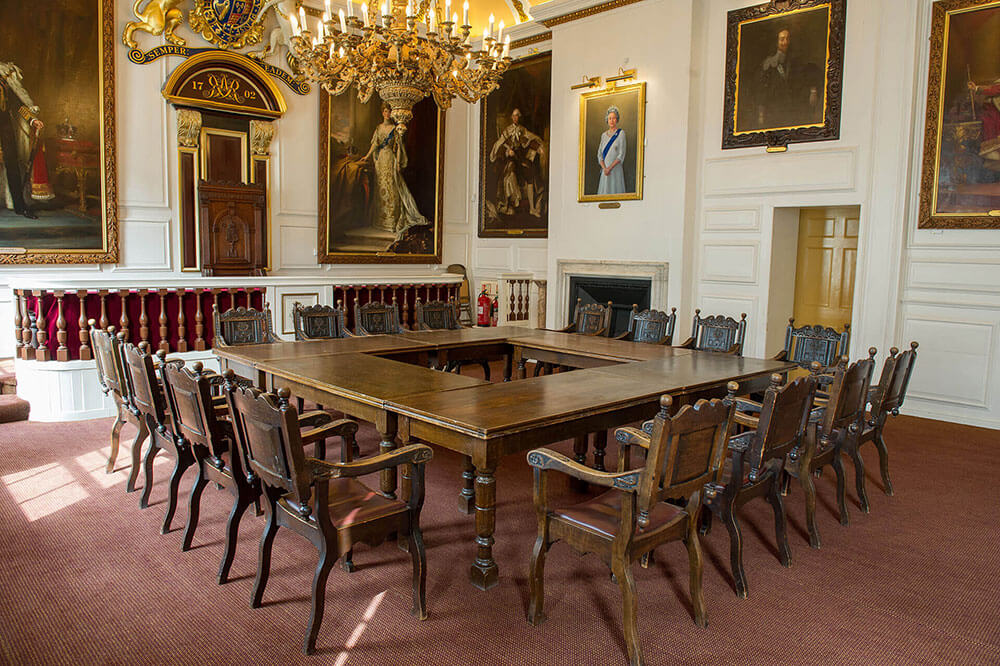
Windsor Guildhall
The present Guildhall was begun in the late 1680s and completed in 1690.
It became the home of Windsor's Town Council, with the Council Chamber sitting above the historic market space.
For generations the building was at the centre of Windsor's civic and democratic life.
The Guildhall remained the home of Windsor's Town Council until the major local government reorganisation of 1974.
Windsor grows and changes
The physical town changed dramatically during the Georgian, Victorian and post-war periods.
As Windsor expanded, the area governed as part of the town changed with it.
Major redevelopment of Windsor Castle in the 19th century helped renew the importance and prosperity of the town.
Railway connections in the 19th century made Windsor more accessible and supported further growth.
Later development spread the town westwards, incorporating areas associated with Clewer and Dedworth into modern urban Windsor.
Large-scale redevelopment during the 20th century transformed parts of the medieval and Victorian town.
This is the year Windsor's local government changed fundamentally.
Windsor's Town Council came to an end
As part of national local government reorganisation, Windsor and Maidenhead were brought together with surrounding areas in a new local authority: the Royal Borough of Windsor & Maidenhead.
Windsor Guildhall ceased to be the home of Windsor's Town Council, and the new borough-wide authority became responsible for local government across a much larger area.
The formal name New Windsor was also replaced by Windsor.
Before and after 1974
The change was not about Windsor ceasing to exist as a community. It changed the structure through which local government was delivered.
Windsor had its own council
Windsor's civic government was centred on the town, with Windsor Guildhall serving as the home of Windsor's Town Council.
A larger Royal Borough
Windsor became part of the Royal Borough of Windsor & Maidenhead, an authority serving Windsor, Maidenhead and surrounding towns and villages.
The Guildhall remains part of civic Windsor
Although it stopped being the home of Windsor's Town Council in 1974, the Guildhall did not lose its civic role.
The Grade I listed building remains owned and used by the Royal Borough and continues to host civic functions, ceremonies and other important occasions.
The question of a Town Council returned
Almost half a century after Windsor's Town Council disappeared, residents began campaigning for dedicated town-level representation again.
A community campaign began in 2019 and led to RBWM undertaking a formal Community Governance Review in 2020.
A community campaign begins
An e-petition was launched seeking support for the creation of a Windsor Town Council. Campaigners argued that Windsor should once again have a council focused specifically on the town.
The review formally starts
RBWM Full Council unanimously approved a Community Governance Review to consider forming a new Town Council for the unparished areas of Windsor.
Draft proposals move forward
Full Council approved the draft recommendations produced by the cross-party working group and a second public consultation on the detailed proposals followed.
is rejected
Full Council decided not to create a Windsor Town Council
After a year-long Community Governance Review, the final recommendation to establish a new Windsor Town Council came before RBWM Full Council.
The proposal was for a Town Council covering 12 polling districts in the unparished parts of Windsor, with 21 elected councillors across 10 wards. The first elections were proposed for May 2023.
RBWM was Conservative-controlled at the time. Following debate, councillors rejected the proposal.
Among those who did respond, roughly 520 supported the principal questions in the consultation and around 100 opposed them, with the remaining responses recorded as “don't know” or unanswered.
Was there a sufficient mandate?
Councillors opposing the proposal argued that the relatively small proportion of the electorate responding did not provide a strong enough mandate to create another tier of local government. Concerns were also raised about cost, bureaucracy and an additional council tax precept.
What did those who responded say?
Supporters pointed out that a Community Governance Review is a consultation rather than a referendum and has no required turnout threshold. They also highlighted that a clear majority of respondents supported the proposals and argued that Windsor needed stronger local representation.
The question is being considered again
The 2021 decision did not permanently settle the question of Windsor's local governance.
In 2026, RBWM began a new Community Governance Review considering whether Town Councils should be created for the currently unparished areas of Windsor and Maidenhead.
The first consultation opened on 5 August 2026 and closes on 30 September 2026. Draft Recommendations are expected later in 2026, with a final decision due in 2027.
If a Windsor Town Council is ultimately approved, the current timetable provides for its first elections in May 2028.
More than 50 years after Windsor's former Town Council ended, residents are therefore once again being asked how their town should be represented locally.
Historical information: this page draws on published local history material, including Royal Borough conservation-area research and the history of Windsor Guildhall held by Windsor Guildhall Museum.
2020–21 Community Governance Review: information about the review and the July 2021 decision is drawn from the published minutes and papers of the Royal Borough of Windsor & Maidenhead Full Council.