The Windsor conversation.
Current updates on the Community Governance Review, together with articles exploring the case for stronger local representation in Windsor.
Windsor residents are being asked for their views
The current Community Governance Review is considering whether a Town Council should be created for the currently unparished parts of Windsor.
The first public consultation opened on 5 August 2026 and closes on 30 September.
Residents can comment on the proposals before RBWM develops its Draft Recommendations.
There will then be further stages of consultation and decision-making before any final decision about a Windsor Town Council is made.
If the review ultimately results in a new Town Council, the current timetable provides for first elections in May 2028.
The current position in simple terms
If you are new to the debate, these are the best places to start.
What happens next?
Follow the timetable from the current consultation through to a possible decision and elections.
See the timetable → The basicsWhat is a local council?
Understand where a Town Council would fit and how it would relate to RBWM.
Explain it simply → In practiceWhat could it do?
Explore the kinds of local projects, facilities and community activity a Town Council could support.
See practical examples →The questions haven't gone away
These articles were originally written during the previous Community Governance Review.
The circumstances and some of the figures have changed since 2020 and 2021, but the issues they explore remain relevant: local representation, accountability, community identity and who gets to make decisions about Windsor.
We have therefore kept them as part of the discussion rather than hiding them away simply because of their age.
Four contributions to the debate
The articles are shown in the order they were originally written, beginning in November 2020.
Is there a democratic deficit?
An opinion piece about declining trust, participation and whether politics feels sufficiently connected to everyday life.
Read article ↓ 18 November 2020Why Have a Town Council at all?
Eight arguments for very local government, from responsiveness and community activity to accountability and long-term planning.
Read article ↓ 22 November 2020Local People Making Local Decisions
Who decides how Windsor's unparished precept is spent, and should Windsor residents have their own elected representatives?
Read article ↓ 11 March 2021Why Windsor needs a Town Council
A letter published in the Maidenhead Advertiser during the previous review, setting out the campaign's case.
Read letter ↓Background to the Windsor Town Council debate
These pieces retain the arguments made at the time, while clearly separating historical facts and figures from the current 2026 review.
Is there a democratic deficit?
Representation, participation and people's connection with politics.
Is there a democratic deficit?
Representation, participation and people's connection with politics.
Do people feel sufficiently connected to the decisions being made on their behalf?
Richard opened the article by considering research suggesting declining confidence in democracy, particularly among younger generations.
He argued that this was part of a wider problem: people may care strongly about issues, but still feel distant from traditional political structures and decision-making.
Participation is changing
The original article looked at voter turnout, political-party membership and the rapid growth of campaigns organised around individual issues.
Richard's point was that a lack of enthusiasm for traditional political organisations should not automatically be mistaken for a lack of interest in public affairs.
People continue to engage strongly with issues that affect them directly: planning, schools, transport, the environment, community facilities and decisions affecting their neighbourhoods.
The role of social media
The article also considered the changing role of social media.
Online platforms can help people organise, share information and mobilise around an issue. They can broaden participation, but they can also amplify the loudest voices and make it difficult to judge how representative a particular campaign really is.
Could more local democracy help?
Richard concluded that part of the democratic deficit comes from the gap between large political structures and the everyday issues that matter to individuals and neighbourhoods.
A very local council cannot solve wider dissatisfaction with politics. But it can create another place where residents can participate, elect representatives, raise issues and see decisions being made at a scale closer to their community.
Why Have a Town Council at all?
What could another, more local tier of government add?
Why Have a Town Council at all?
What could another, more local tier of government add?
Richard Endacott's argument began with one word: community.
Having lived in Windsor for many years, attended local schools and been involved in sport, education and civic life, he described Windsor as a town whose communities are strongly interconnected.
Clewer, Dedworth, Spital and the town centre may have distinct identities, but together they form a community with a strong attachment to Windsor.
Why add a Town Council?
The article argued that a borough-wide council inevitably has to balance priorities across a large geographical area and concentrate resources on major statutory services.
A smaller local council, by contrast, could concentrate on the particular priorities of one town and its communities.
Richard drew on research into community and town councils which identified a number of potential benefits.
Windsor's day-to-day priorities
The article argued that residents often care deeply about relatively small local issues: the condition of open spaces, community facilities, improvements to neighbourhoods, local events and the appearance of the town.
These may not always be the largest responsibilities of local government, but they can make a considerable difference to how people experience the place where they live.
Richard's central case was therefore not that a Town Council should replace the Royal Borough, but that a more local body could concentrate specifically on Windsor and the things Windsor residents value.
Local People Making Local Decisions
Taxation, representation and who decides local priorities.
Local People Making Local Decisions
Taxation, representation and who decides local priorities.
The starting question was simple: Windsor residents were paying an unparished precept, but who was deciding what that money should be used for?
John Webb wrote that he first became aware of the campaign for a Windsor Town Council in 2019. His interest began when he discovered a separate unparished precept on his Council Tax bill.
At the time, his Band D contribution was around £32 a year. The amount itself was not the main concern. What troubled him was that he found it difficult to establish precisely what the charge was paying for and who had democratic responsibility for deciding those priorities.
What was the unparished precept paying for?
The 2020 arrangements calculated special expenses across the unparished areas of Windsor and Maidenhead. The areas identified at the time included:
- allotments
- street and footway lighting
- recreation grounds and open spaces
- administration associated with the Town Forum
His concern was that residents in nearby parished areas had councillors elected specifically to their Parish or Town Council, whereas residents of unparished Windsor did not have that equivalent tier of representation.
The representation argument
Surrounding communities such as Datchet, Bray, Eton and Old Windsor already had Parish or Town Councils. Those councils could consider local priorities, set their own precept and decide how local money should be used within the powers available to them.
The article argued that the same principle should apply to Windsor: residents should be able to elect representatives whose specific responsibility was the community in which they lived.
What opportunities could that create?
John suggested that a Town Council could potentially give Windsor a clearer focal point for local activity. Areas he highlighted included:
- coordinating residents' views
- supporting community projects and initiatives
- helping organise events and festivals
- providing a local voice on Windsor issues
- accessing funding and other opportunities available to local councils
His broader argument was that decisions which primarily affect Windsor should, wherever practical and lawful, involve people elected specifically to represent Windsor communities.
Why Windsor needs a Town Council
A letter published in the Maidenhead Advertiser.
Why Windsor needs a Town Council
A letter published in the Maidenhead Advertiser.
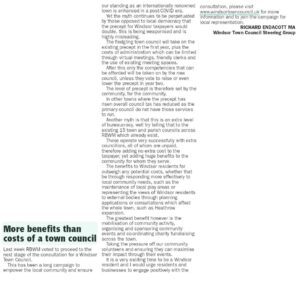
The letter made the case that the potential benefits of a Windsor Town Council were greater than the additional administrative costs.
Richard argued that concerns about cost needed to be considered alongside the choices that an elected Town Council itself would eventually make about its priorities, budget and services.
He also challenged the suggestion that a Town Council would simply amount to unnecessary bureaucracy, pointing to the Parish and Town Councils already operating elsewhere in the Royal Borough.
The benefits he highlighted
- responding more directly to community needs
- supporting and maintaining local facilities
- representing Windsor residents to external organisations
- commenting on issues such as planning and major consultations
- supporting community events
- helping coordinate local fundraising and voluntary activity
His strongest argument was that a Town Council could provide an organisation whose sole community focus was Windsor.
The letter encouraged residents and businesses to engage with the consultation and take part in deciding what form of local representation Windsor should have.
What happened to the previous proposal?
The earlier Community Governance Review began in 2020 and progressed to formal Draft Recommendations for a Windsor Town Council.
Those Draft Recommendations were approved for a second round of consultation by Full Council on 2 March 2021.
The final proposal was later considered by Full Council in July 2021, but a Windsor Town Council was not established.
The current 2026 Community Governance Review is therefore a new review, rather than a continuation of the 2021 proposal.
View the 2021 Draft Recommendations →Now it is Windsor's opportunity to consider the question again
The current consultation closes on 30 September 2026. Whether you support a Town Council, oppose one or are still undecided, your view matters.